
Showing posts with label edibles. Show all posts
Showing posts with label edibles. Show all posts
Wednesday, February 27, 2013
Acorn experiment #2 - Pancakes
I had some flour from a second batch of valley oak acorns that I had accidentally broiled instead of drying in my broiler. I forgot they were drying under the pilot light and I turned on the oven to cook dinner. Oops. The flour looked good, but I didn't want to serve it to guests just in case. So the other night I decided to try out one of the many acorn pancake recipes I saw on the internet. I finally went with the recipe for acorn griddle cakes at the bottom of this page, but didn't use any wheat flour, just 100% acorn flour, and I think alot more milk. These things were bone dry. I wonder if the recipe is supposed to be made with the damp, freshly leached acorn meal. They were still pretty dry once I cooked them, so I had to use a lot of butter (no complaints here). But they were delicious. The acorn had a great flavor. Served with salmon and a side salad.


Wednesday, December 19, 2012
Acorns for dinner!
So after I leached and dried my acorn flour I invited some friends over for an experimental dinner. I invited the 2 friends who helped me gather and then another friend stopped by purely by coincidence. I decided to make 2 different dishes with the 2 different acorns. I wanted to compare, though the dishes tasted so different it's hard to say which acorn tasted better.
With the black oak acorns I decided to make a soup. I found a recipe for acorn soup online. As always I changed the recipe a bit, substituting things I didn't have or that didn't sound like what I wanted. I didn't have the pear brandy so I substituted red wine. I also never added the cayenne, sour cream, or parsley.
 With the valley oak acorns I decided to make a scramble, an idea I got from Flavors of Home by Margit Roos-Collins. Basically I just sauteed garlic in butter and then added some damp acorn flour, some salt and pepper.
 I paired this with some broiled salmon with a fresh raspberry sauce and some salad made by one of the guests.
The soup was a bit tangy/sour. The two friends who helped gather preferred the soup since they liked that tangy taste. My other friend and I preferred the scramble. Garlic and butter, how can you go wrong with that? A delicious meal. I just finished another round of valley oak acorns. I have about 2 1/4 cups of flour. I'm thinking of trying some acorn pancakes, before preparing the rest of my acorns for a larger dinner in January. And I still have to sample some Tanoak acorns I collected on Mt. Tam.
With the black oak acorns I decided to make a soup. I found a recipe for acorn soup online. As always I changed the recipe a bit, substituting things I didn't have or that didn't sound like what I wanted. I didn't have the pear brandy so I substituted red wine. I also never added the cayenne, sour cream, or parsley.


The soup was a bit tangy/sour. The two friends who helped gather preferred the soup since they liked that tangy taste. My other friend and I preferred the scramble. Garlic and butter, how can you go wrong with that? A delicious meal. I just finished another round of valley oak acorns. I have about 2 1/4 cups of flour. I'm thinking of trying some acorn pancakes, before preparing the rest of my acorns for a larger dinner in January. And I still have to sample some Tanoak acorns I collected on Mt. Tam.
Wednesday, November 21, 2012
Leaching Acorn Meal
So as promised, here's a little more information about leaching the acorns. Acorns have tannins, a lot of tannins. Most acorns have so many tannins that they are not edible without leaching. Some possible problems that I've read they can cause are constipation, stomach upset, nausea or even kidney failure. Yikes. So what to do. You have to leach the tannins out with water.
First you have to grind or pound the acorns into flour. I used a spice/coffee grinder to do this the first time, and a blender the 2nd. With the blender make sure you don't put too much water or the bits of acorn will spin around without actually being chopped down Then to leach out the tannins there are many options. Native Californians diverted streams over beds in the sand, some people boil the acorns changing the water, or pour hot water over it, others pour cold water over the acorn flour, or tie it to a faucet in cheese cloth and let it drip over night.
 I opted for yet another option I found on page 5 of Suellen Ocean's "Acorns and Eat 'Em". I didn't need the flour right away, so I put the acorn flour in a jar and filled it with water. I shook it up and put it in the fridge to let the flour settle out. Once or twice a day I would pour the dark, tannin-filled water off the top, fill the jar with fresh water and put it back in the fridge. I read you need to do this for a week or 2, depending on the type of acorn, until the water gets clearer. After two weeks, the water was definitely lighter, but still pretty dark. So I decided to run some water through it. I lined a strainer with cheese cloth and dumped the acorn meal in. I left a small stream of water pouring out of the faucet to keep the strainer filled with water for a couple hours. Normally you do this overnight, but I had already leached a lot of the tannins out in the jar.

 I learned that cheesecloth is not the best method to do this. A lot of the acorn flour got stuck between the layers of cheesecloth. It was difficult to remove. So round 2 I used a linen dishcloth. Much better. I had no immediate need to use the flour, so I squeezed out as much water as possible, spread it out on a cookie sheet and put it in a warm oven. Stir it occasionally and break up any clumps. When you're sure it's dry you can store it. Many things I read said to store it in the fridge since acorn flour has a lot of oil and can go rancid if stored at room temperature for too long. Others said it's not a problem, but to be safe I stored it in the fridge.
 On my second round there was less flour. After two weeks the water was pretty clear. I put it in the strainer and just filled the strainer a few times until the water ran clear, then dried that flour as well. Now I had some flour to experiment with, which I'll describe in my next post.
First you have to grind or pound the acorns into flour. I used a spice/coffee grinder to do this the first time, and a blender the 2nd. With the blender make sure you don't put too much water or the bits of acorn will spin around without actually being chopped down Then to leach out the tannins there are many options. Native Californians diverted streams over beds in the sand, some people boil the acorns changing the water, or pour hot water over it, others pour cold water over the acorn flour, or tie it to a faucet in cheese cloth and let it drip over night.


Wednesday, November 14, 2012
Acorns - The Harvest
Well it's been a very long time since I last blogged. A little harder to keep up with this when I no longer have a garden. I've been doing a lot of hiking and camping in the last 6 months. Perhaps more on that later. But since it's Fall and Thanksgiving is approaching I thought I'd post about my current attempt to eat acorns for the first time.
I attempted to harvest some last year, but got to it too late and basically got a small amount of wormy acorns. Not fun. This year I was a lot luckier. I was able to collect acorns from both the California Black Oak (Quercus keloggii) and the Valley Oak (Quercus lobata). *The common names are often used in other regions to refer to different oaks* As you can see from the picture the acorns look very different.
 The black oak acorns are on the left above. They are much smaller and rounder. The valley oak acorns on the right are much longer and bigger. And once they are cracked they are very different as well.

 Just to confuse you all, in the bowls, the shelled valley oak acorns are now on the left and the black oak acorns on the right. The black oak acorns have a very difficult to remove skin. Especially hard with undersized acorns of which I had more than my fair share. I read somewhere to sprinkle them with water, let them dry and then rub the skins off. I had to do this twice, but it definitely helped speed up the process.
 Then into my spice grinder and the flour (which smells really nice) into a jar with some cold water. And into the fridge. You have to leach the tannins out of acorns to make them safe to eat. More on my adventures in leaching the acorn flour in my next post.
I attempted to harvest some last year, but got to it too late and basically got a small amount of wormy acorns. Not fun. This year I was a lot luckier. I was able to collect acorns from both the California Black Oak (Quercus keloggii) and the Valley Oak (Quercus lobata). *The common names are often used in other regions to refer to different oaks* As you can see from the picture the acorns look very different.


Monday, February 28, 2011
No snow and California bay nuts
So the forecast for this last weekend was for snow in the SF Bay Area. They were even forecasting snow down to sea level. I was pretty excited. But there was no snow. I should have known better than to trust a weather forecast.
In other news, I finally roasted some California bay (laurel) nuts. As you might have read in another post, I collected some back in November. And I finally got around to roasting them recently. Flavors of Home suggested roasting them in a 350 degree oven for about 30 minutes. It seems a little less might be better.
The first time I roasted them for a little longer and they tasted like burnt popcorn. I tried it again and took out the nuts at different times (between 25-35 min of roasting). Too little and they taste a little raw/bitter. Too long and they taste too burnt, but even when cooked right they still have the taste of burnt popcorn to me. When I told this to a friend, he immediately asked, "Burnt popcorn in a good or bad way?" Sometimes burnt popcorn is not so bad. So I would say burnt popcorn in a good way. I can really see eating a lot of them, but they definitely weren't bad. I have a few more nuts, so I'm gonna try one more round and experiment a little more.
For another blog post and video on roasting them check out FeralKevin. (Thanks for the link Katie)
In other news, I finally roasted some California bay (laurel) nuts. As you might have read in another post, I collected some back in November. And I finally got around to roasting them recently. Flavors of Home suggested roasting them in a 350 degree oven for about 30 minutes. It seems a little less might be better.
The first time I roasted them for a little longer and they tasted like burnt popcorn. I tried it again and took out the nuts at different times (between 25-35 min of roasting). Too little and they taste a little raw/bitter. Too long and they taste too burnt, but even when cooked right they still have the taste of burnt popcorn to me. When I told this to a friend, he immediately asked, "Burnt popcorn in a good or bad way?" Sometimes burnt popcorn is not so bad. So I would say burnt popcorn in a good way. I can really see eating a lot of them, but they definitely weren't bad. I have a few more nuts, so I'm gonna try one more round and experiment a little more.
For another blog post and video on roasting them check out FeralKevin. (Thanks for the link Katie)
Wednesday, November 24, 2010
Bay Area Foraging Successes?
So I've tried a couple of things I foraged or wrote about a while ago. I left you all hanging with my last post, but I still haven't tried the laurel nuts. I'm thinking I'll try and roast them this weekend. I did however try the fruit. Hmmm? How to describe it? As you can see in this pic, it looks like a tiny round avocado.
 Pretty cool looking really. The flesh was much firmer, so I'm not sure it was ripe. I read you're supposed to wait till the fruit turns purple before eating. Most of the fruit was purple, but maybe it wasn't long enough. I think I've lost the opportunity to try again this year, but it was hard to motivate after tasting it. What did it taste like? I only tried tiny nibbles. One was hard and didn't taste like much. The other was like chewing on a fleshy bay leaf. A really strong bay leaf. Blech. It took me a while to get the taste out of my mouth. Here's hoping the nuts are tastier.
 I have had some better success with some infusions, or teas. I tried both a fresh and a dried rose hip tea, made from hips of Rosa californica. There didn't seem to be much difference between fresh and dried. It tastes like vitamin C, if that makes sense. Not bad, a little sweet. I also tried adding a couple of hips to other teas. The taste definitely powers through, but fortunately I like the taste.
I also tried an infusion of madrone (Arbutus menziesii) bark. I really like this stuff. I've had it a couple times now. In Flavors of Home, Margit Roos-Collins describes the flavor as "a little like Chinese green tea mixed with the fragrance of bark or wood. It's flavor is homey and a little musty, like the smell of a room full of books that has been closed up for a season by the ocean." I don't know about that last part, but I do know I had forgotten how she described the flavor and after my first couple of sips, I thought to myself that it tasted like green tea. But an earthy green tea. It's very pleasant. I've mixed it with rose hips and white sage. So far I think I like it on its own.
And last, but not least, I tried madrone berries. I don't know if I've never paid attention before, but I have seen tons of madrone berries this year, both in the East Bay and on a trip up north to Mendocino. The hills along one section of 101 south of Ukiah was blazing red with all the berries. I finally spotted a tree with low-hanging branches on the side of a small road, and picked some. I don't think they were ripe. They were kind of hard and astringent. Ms. Roos-Collins did say in her book, that fruits vary in taste from tree to tree. I'm supposed to hike on Thanksgiving, so I'll look for some more.


I also tried an infusion of madrone (Arbutus menziesii) bark. I really like this stuff. I've had it a couple times now. In Flavors of Home, Margit Roos-Collins describes the flavor as "a little like Chinese green tea mixed with the fragrance of bark or wood. It's flavor is homey and a little musty, like the smell of a room full of books that has been closed up for a season by the ocean." I don't know about that last part, but I do know I had forgotten how she described the flavor and after my first couple of sips, I thought to myself that it tasted like green tea. But an earthy green tea. It's very pleasant. I've mixed it with rose hips and white sage. So far I think I like it on its own.
And last, but not least, I tried madrone berries. I don't know if I've never paid attention before, but I have seen tons of madrone berries this year, both in the East Bay and on a trip up north to Mendocino. The hills along one section of 101 south of Ukiah was blazing red with all the berries. I finally spotted a tree with low-hanging branches on the side of a small road, and picked some. I don't think they were ripe. They were kind of hard and astringent. Ms. Roos-Collins did say in her book, that fruits vary in taste from tree to tree. I'm supposed to hike on Thanksgiving, so I'll look for some more.
Tuesday, September 21, 2010
Wild Berries in the Sierra Nevada


The first berries we found were along a creek on some species of Ribes. They had thorns on the stems so they would fall under the common name gooseberry I think. Not sure which one specifically since our book just said there were various species of Ribes scattered throughout the Sierras. It had small red berries. Near the creek, they were a little mealy and not so sweet, but higher up they had a pleasant tartness balanced with a little sweetness.
In the same area we found twinberries. Beautiful, plump glossy berries looking like conjoined twins. My recent favorite book Flavors of Home describes them as officially edible, but not good to eat, at least here in California. Further north in Oregon, they are supposedly prized and considered tasty, here in California no mention is made. I now understand why. I tried one, just to see, even after my friend said they weren't worth it. It had a pretty foul taste. So foul we had to go back and eat some more Ribes berries to get the taste out of our mouth. Ah well.
On the last day, on our way home, we stopped for another short hike. We walked through the woods, it was quite beautiful, but then we found some thimbleberries. I had heard they were really good, but had never found them ripe. They are really good. They are kind of like a small fragile raspberry in the shape of a thimble (hence their name). They have a very nice, but complex flavor. Very good.


Wednesday, September 8, 2010
Wild Late Summer Harvest
Inspired by the book The Flavors of Home, which I wrote about in a previous post, I decided to try and find a few of the things that are available in August or September.
First I decided to look for some California hazelnuts which are ripe in July and August. While hiking in Huckleberry a few weeks ago I was unsuccessful. But this last week in Marin I was, though not very. Although there were many hazelnut bushes along the trail, I found only two, count them, two California hazelnuts. I ate one on the trail and saved the other to take some pictures.

 The book warns that they are a favorite of squirrels and so hard to find. It tasted kind of like a walnut to me. I don't think I've ever had hazelnuts outside of chocolate though, so I'm no expert. The green sheath below surrounds the nut when it's not yet ripe. And then dries to brown as the nut ripens. Be careful though. There are a lot of tiny hairs on it that will stick in your fingers and hands. Felt kind of like nettle. Peeling the first one, I only got a couple, the second a handful of stinging hairs. The first seemed drier. I wonder if that made the difference. Then you've got to crack the nut to get to the meat.
 Next up was madrone bark. This is the time of year when sheets of the bark starts to dry and curl on the tree and is easily removed. It's used to make an infusion (i.e. tea). I haven't tried it yet, but will definitely blog about it when I do.

 And last up were rose hips of one of our native wild roses. Much like the hazelnuts, I've seen lots of wild roses lately, but almost no hips. That is until I stumbled upon a small group of bushes covered with hips. They are very tiny in comparison to the domesticated varieties. I'm not sure I took enough for more than a cup of tea, but when I have it I'll blog about that as well.

 I was trying to dry them whole, but then decided to cut them in half and dry them in a low oven for about 30 min as per the book's suggestion. Rose hips are high in vitamin C. And rose hip oil is commonly used in parts of Latin America to minimize scarring and as an anti-aging cream. I tried one on the trail. It was pretty mealy. Not so great. The book does say that some bushes have better tasting hips than others and if you find mealy ones, to move on. But those were the only hips I've seen in weeks.
First I decided to look for some California hazelnuts which are ripe in July and August. While hiking in Huckleberry a few weeks ago I was unsuccessful. But this last week in Marin I was, though not very. Although there were many hazelnut bushes along the trail, I found only two, count them, two California hazelnuts. I ate one on the trail and saved the other to take some pictures.


Monday, July 5, 2010
Bay Area Edible Plants - The Flavors of Home Book Review
So my trip to Huckleberry Preserve looking for ripe berries was in part inspired by a book I bought a few months ago. The Flavors of Home - A Guide to Wild Edible Plants of the San Francisco Bay Area by Margit Roos-Collins, published by Heyday Books of Berkeley. This is a great book that talks about many edible species of plants, both native and introduced, that are commonly found here in the Bay Area. It details where to find them and when and gives some information on identifying the plants.
Some of the descriptions and illustrations leave something to be desired, so you'll want to find another book or person who knows to help you ID plants before chomping your way through the woods. But once you are absolutely sure you can ID the plant and know which parts are edible it makes a nice addition to your hike. I sometimes eat things on hikes or gather them to bring them home, and people I know often ask me if I'm sure it's edible, or how I know I can eat that, distrusting the food that grows all around us. There are poisonous plants that grow here, but Roos-Collins addresses this in one of my favorite lines of the book found in the introduction: "Just remember that we are programmed through millions of years of evolution, to be naturally good at foraging. Anyone who can tell a cabbage from a head of iceberg lettuce can learn to select edible wild plants with confidence."
Some of the plants she mentions I've already eaten, like miners' lettuce and nasturtium. One of the more interesting chapters was on edible seaweeds. I haven't tried any of those yet, and have been fairly cautious but I have tried some things already that I read about in the book. I ate some chickweed, a leafy green weed that grows in all sorts of places, including people's gardens. And I ate some madrone blossoms. They were very interesting. The blossoms had a papery texture, but then a very pleasant sweet aftertaste. Hopefully soon I'll be able to add to the list.
Some of the descriptions and illustrations leave something to be desired, so you'll want to find another book or person who knows to help you ID plants before chomping your way through the woods. But once you are absolutely sure you can ID the plant and know which parts are edible it makes a nice addition to your hike. I sometimes eat things on hikes or gather them to bring them home, and people I know often ask me if I'm sure it's edible, or how I know I can eat that, distrusting the food that grows all around us. There are poisonous plants that grow here, but Roos-Collins addresses this in one of my favorite lines of the book found in the introduction: "Just remember that we are programmed through millions of years of evolution, to be naturally good at foraging. Anyone who can tell a cabbage from a head of iceberg lettuce can learn to select edible wild plants with confidence."
Some of the plants she mentions I've already eaten, like miners' lettuce and nasturtium. One of the more interesting chapters was on edible seaweeds. I haven't tried any of those yet, and have been fairly cautious but I have tried some things already that I read about in the book. I ate some chickweed, a leafy green weed that grows in all sorts of places, including people's gardens. And I ate some madrone blossoms. They were very interesting. The blossoms had a papery texture, but then a very pleasant sweet aftertaste. Hopefully soon I'll be able to add to the list.
Saturday, June 26, 2010
Huckleberry Preserve - Attempted berry foraging edition
So I went up to Huckleberry preserve in hopes of finding thimbleberries, a native, and supposedly delicious berry I have yet to taste. Well the first plants I found were only in flower. And while there were some berries after all further down the trail, none of them were ripe yet. It will have to wait till later.
 This park always amazes me with it's variety of native plants and a wonderful, quiet beauty. Here is filtered sunlight on California grape.

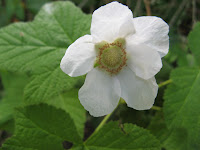
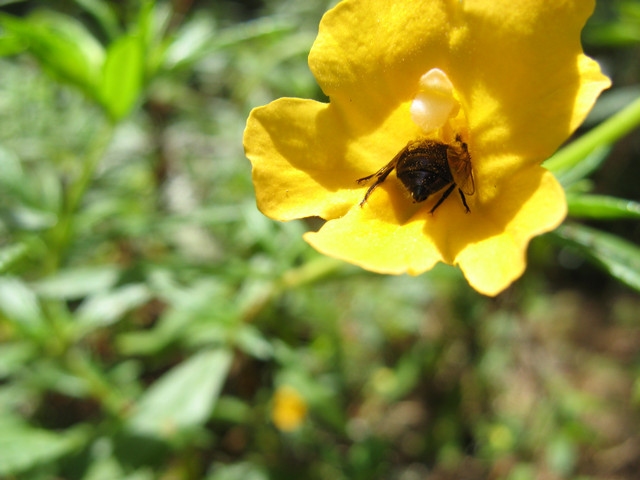
 I also saw a bee at work on these blackberry blossoms and another one that seems to have passed out drunk from the monkeyflower nectar. He didn't move for a good minute or more. Better for my camera.

 I don't know if I'm more aware, but I swear that some plants are more common now than just a few years ago. California rose for example is scattered along the trail in quite a few spots now. Here's a rosehip just starting to form. And although most of the rose blooms were done for the year, a few more were getting ready to open.

 Another reason I came to the preserve was to look for California hazelnuts (Corylus cornuta var californica). Also edible, but not quite ripe. A very strange, but beautiful housing for the future nuts. And the buds just awakening.

 And I wanted to see if there were any ribes berries to sample. The ribes species that grow in the park I don't think are very tasty, but I'm still curious to try some. They weren't ripe either.
 It seems like our wet and late winter pushed some things back from their usual cycle. Luckily I didn't mind just having a pleasant walk through the woods.




Subscribe to:
Posts (Atom)