So on a hike about 2 weeks ago with some friends, I saw two birds in an unexpected place. I see these birds all the time, but I don't usually expect to see them in the trees.
The first was what we believe was a juvenile red-tailed hawk. Red-tailed hawks (Buteo jamaicensis) are very common not just here in California, but throughout North America, and their range extends to islands in the Caribbean and down through Central America. They are quite variable in coloring and here in the West they have three forms, light, dark and intermediate. The dark are completely dark brown, so it looks like that's what we've got below. For more pics and more info, check out this post on 10000 Birds.
The second bird was a turkey vulture (Cathartes aura), just sitting in a tree a mere 20 feet from the trail. It wasn't a tree on the edge of a clearing, we were in the woods. We thought maybe it was hiding from something, but really we had no idea. This bird too is a juvenile. It's head is grey instead of the characteristic red of the adults. Turkey vultures are the most widespread of the New World vultures from Southern Canada to the end of South America.
These are two birds I think of when I think of open space here in California. I often see them on hikes or long car rides in less populated areas. But it looks like people all over North America probably think the same.
And as an added bonus, here's a pic of a heron (I believe it's a great blue heron) that I saw while paddling down the Russian River in a canoe over Labor Day weekend.
Showing posts with label wildlife. Show all posts
Monday, September 13, 2010
Saturday, May 8, 2010
UC Berkeley California Native Bee Garden
So I also went to the CA native Bee Garden at UC Berkeley as part of the Bringing Back the Natives Tour (see my previous post). I had been two years ago, and probably wouldn't have gone again if my cousin, Marissa, wasn't working there. I ran into Marissa on the tour there 2 years ago, not knowing she was helping her professor do native bee research. And now that she's graduated she has a job doing research.
I'm glad I did go this year. The garden is looking much nicer and Marissa gave me a little private tour of the garden, interrupted frequently by other people who were curious to know about the bees or the plants. So here are some of the more interesting things I learned while there. (And for more info visit the garden's website.)
None of our native bees live in hives. The bees you see this year actually emerge from nests that were laid last year by solitary females. The male bees tend to hatch a few days earlier than the females and then stake out some flowers and patrol them, either to protect a nectar/pollen source for females of their own species, or more importantly to mate with a female who will (hopefully) visit those flowers looking for pollen or nectar. If you see a bee zooming around and around a particular patch of flowers, you're looking at a male. Females will come to gather pollen and go back to their nest. The guys want to cruise and the ladies are all business. And only the females can sting. Stingers are modified ovipositors, which males don't have.
Most native bees dig holes into the ground to make their nests, so don't mulch your whole yard. Leave some areas unmulched to provide nesting habitats for the bees. Some will dig a vertical shaft down and then dig out horizontally in a spoke-like pattern to create individual cells for each egg. Each cell is lined with a waterproof coating and each egg is laid with with a bit of bee bread, a mix of pollen, nectar and bee saliva. They then hatch, eat, grow, and then go dormant to stay underground until the following year.
Many of our species of native bees only come out into the open for a few weeks. They mate, the females build their nests and then die. Their emergence from underground is often timed to match the blooms of favorite species.
There are approximately 1600 species of bees (mostly native) in California. This is an amazing number considering the US has about 4000 species total and there are an estimated 25,000 in the world. And our adult bees vary in color and in size from the size of a grain of rice to big furry ones the size of bumblebees (very different) or bigger. We have leafcutter bees (Megachilidae family, which I've seen in my own garden), headbonker bees (Anthidium sp.), carpenter bees and green sweat bees. The leafcutters cut pieces off of leaves to help build their nests. Headbonkers are called that because the males pick a plant and guard it. They will actually bonk bees off the flowers to protect the nectar and pollen for themselves or their females.
The blue orchard bee (Osmia sp.) and some other species live in tunnels found in old wood (preferably oaks). So at the garden the researchers drill holes into blocks of wood of varying widths to attract bees to nest in them. Since the young bees stay in the nest until the following year, the blocks can be transported to a new area. Because of this and of CCD (Colony Collapse Disorder) affecting honeybees, these bees are being used more frequently for agriculture.
And most importantly native CA bees prefer native CA plants. They will also gather pollen and nectar from some non-natives, and the bee garden is doing research to see what plants are useful resources for bees, but in general they prefer the plants they have co-evolved with. Go figure.
For more info and pics on individual species at the garden check out this article at baynature.org. And also here is the list of plants from the garden with details about which bees they attract and some planting advice.
I'm glad I did go this year. The garden is looking much nicer and Marissa gave me a little private tour of the garden, interrupted frequently by other people who were curious to know about the bees or the plants. So here are some of the more interesting things I learned while there. (And for more info visit the garden's website.)
None of our native bees live in hives. The bees you see this year actually emerge from nests that were laid last year by solitary females. The male bees tend to hatch a few days earlier than the females and then stake out some flowers and patrol them, either to protect a nectar/pollen source for females of their own species, or more importantly to mate with a female who will (hopefully) visit those flowers looking for pollen or nectar. If you see a bee zooming around and around a particular patch of flowers, you're looking at a male. Females will come to gather pollen and go back to their nest. The guys want to cruise and the ladies are all business. And only the females can sting. Stingers are modified ovipositors, which males don't have.
Most native bees dig holes into the ground to make their nests, so don't mulch your whole yard. Leave some areas unmulched to provide nesting habitats for the bees. Some will dig a vertical shaft down and then dig out horizontally in a spoke-like pattern to create individual cells for each egg. Each cell is lined with a waterproof coating and each egg is laid with with a bit of bee bread, a mix of pollen, nectar and bee saliva. They then hatch, eat, grow, and then go dormant to stay underground until the following year.
Many of our species of native bees only come out into the open for a few weeks. They mate, the females build their nests and then die. Their emergence from underground is often timed to match the blooms of favorite species.
There are approximately 1600 species of bees (mostly native) in California. This is an amazing number considering the US has about 4000 species total and there are an estimated 25,000 in the world. And our adult bees vary in color and in size from the size of a grain of rice to big furry ones the size of bumblebees (very different) or bigger. We have leafcutter bees (Megachilidae family, which I've seen in my own garden), headbonker bees (Anthidium sp.), carpenter bees and green sweat bees. The leafcutters cut pieces off of leaves to help build their nests. Headbonkers are called that because the males pick a plant and guard it. They will actually bonk bees off the flowers to protect the nectar and pollen for themselves or their females.
The blue orchard bee (Osmia sp.) and some other species live in tunnels found in old wood (preferably oaks). So at the garden the researchers drill holes into blocks of wood of varying widths to attract bees to nest in them. Since the young bees stay in the nest until the following year, the blocks can be transported to a new area. Because of this and of CCD (Colony Collapse Disorder) affecting honeybees, these bees are being used more frequently for agriculture.
And most importantly native CA bees prefer native CA plants. They will also gather pollen and nectar from some non-natives, and the bee garden is doing research to see what plants are useful resources for bees, but in general they prefer the plants they have co-evolved with. Go figure.
For more info and pics on individual species at the garden check out this article at baynature.org. And also here is the list of plants from the garden with details about which bees they attract and some planting advice.
Labels:
wildlife
Thursday, March 25, 2010
Anna's Hummingbird (Calypte anna)
So I saw this little guy in Huckleberry Botanic Preserve about a month ago. I've been slow on the postings. I was up in the manzanita barren when I heard the telltale chirp of the humming bird. I looked up and saw it fly straight up and then dive down to a manzanita a ways off.
It kept going back and forth between a couple plants (a chinquapin and manzanita) and basically looked to be putting on a show, whether for me or something else, I'm not sure. Here he is silhouetted against the sky.
Here you'll find a little description and a recording of their call. Be sure to click on the life history tab. Apparently Anna's hummingbird used to only breed in Northern Baja and Southern California, but with all of us happy gardeners doing our work, they have greatly expanded their breeding range.
Mainly I identified it because I know this hummingbird has a bright iridescent red or pink throat and is common here in the Bay Area. And evidently it's the only one that overwinters here regularly. We have a resident one here at the house that often chirps from high above or lands on our neighbor's plum tree. I've seen him drinking nectar from arugula, columbine, fuchsia, California fuchsia, various salvia, citrus blossoms and I think the passionflower.
It kept going back and forth between a couple plants (a chinquapin and manzanita) and basically looked to be putting on a show, whether for me or something else, I'm not sure. Here he is silhouetted against the sky.
Here you'll find a little description and a recording of their call. Be sure to click on the life history tab. Apparently Anna's hummingbird used to only breed in Northern Baja and Southern California, but with all of us happy gardeners doing our work, they have greatly expanded their breeding range.
Mainly I identified it because I know this hummingbird has a bright iridescent red or pink throat and is common here in the Bay Area. And evidently it's the only one that overwinters here regularly. We have a resident one here at the house that often chirps from high above or lands on our neighbor's plum tree. I've seen him drinking nectar from arugula, columbine, fuchsia, California fuchsia, various salvia, citrus blossoms and I think the passionflower.
Labels:
wildlife
Tuesday, January 12, 2010
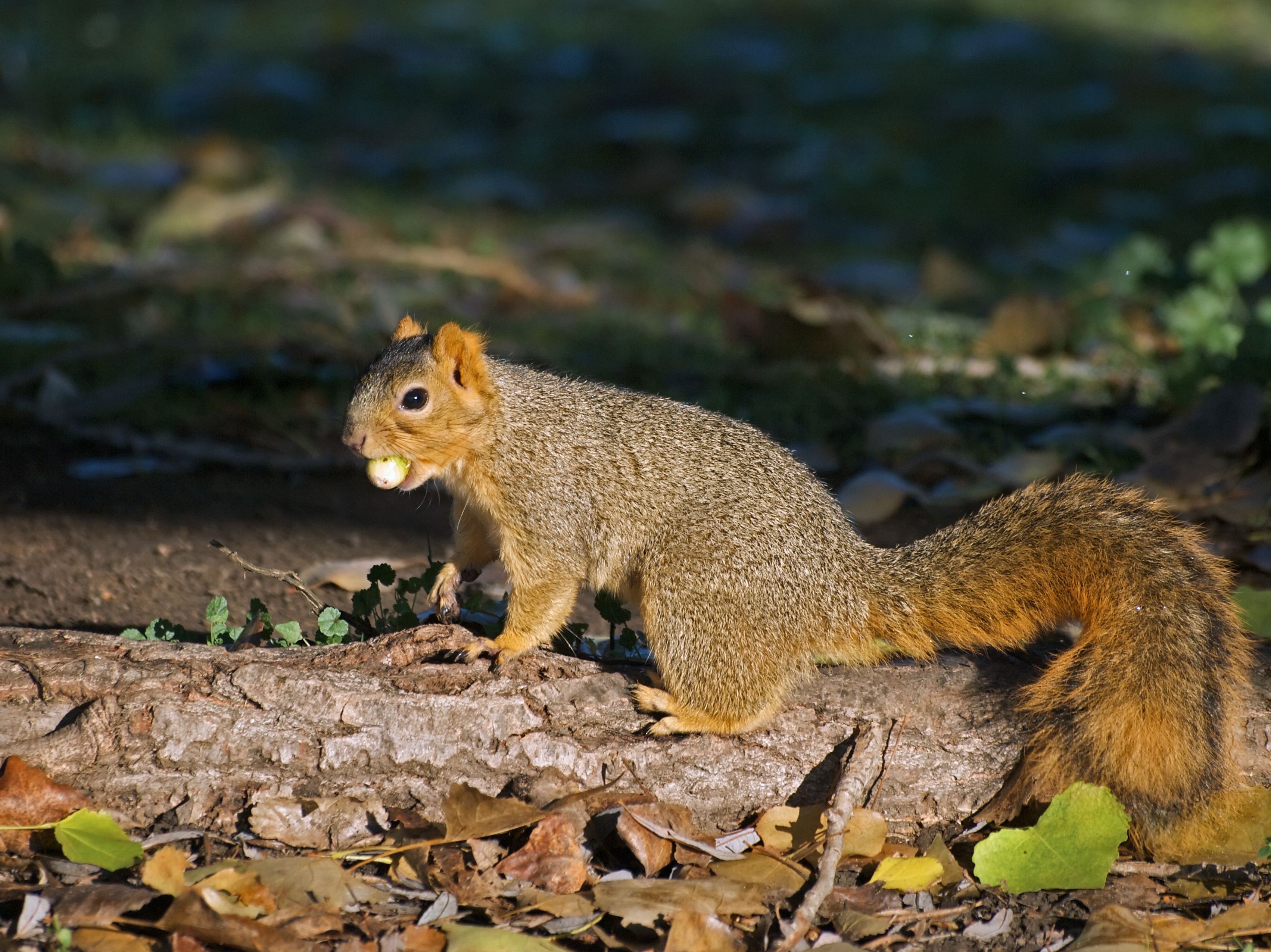
Eastern Fox Squirrel aka bane of my existence or Sciura niger
So while eating breakfast the other day, I found our resident squirrel scurrying in our backyard. In the fall and early winter he tends to dig up all my potted plants in an effort to hide acorns, or sometimes I think just to annoy me. This year actually it wasn't that bad. It might be because last year I sprinkled copious amounts of chile powder and put little squirrel size stakes (read toothpicks) in the pots that got the most attention. It didn't stop the little guy but it definitely slowed him down.
Pic from here.
Today though it was digging through the mulch in our path. I assumed it was looking for some acorns it had left buried, but then i saw it had something in it's mouth, much bigger than an acorn. My view was obscured by a potted plant at first, but then it looked like an animal of some sort in its mouth. It scampered off onto the lemon tree and over the garage roof and disappeared. I'm still not sure what it was, but I think it was a small lizard, or little vole or something. (Really not sure because I was inside and upstairs.)
But this prompted a search via teh interweb and I found that my resident squirrel is an introduced species from back East, the Eastern Fox Squirrel (Sciura niger) and that they on occasion eat insects, birds' eggs, small birds and lizards. I had no idea.
Pic from here.
Today though it was digging through the mulch in our path. I assumed it was looking for some acorns it had left buried, but then i saw it had something in it's mouth, much bigger than an acorn. My view was obscured by a potted plant at first, but then it looked like an animal of some sort in its mouth. It scampered off onto the lemon tree and over the garage roof and disappeared. I'm still not sure what it was, but I think it was a small lizard, or little vole or something. (Really not sure because I was inside and upstairs.)
But this prompted a search via teh interweb and I found that my resident squirrel is an introduced species from back East, the Eastern Fox Squirrel (Sciura niger) and that they on occasion eat insects, birds' eggs, small birds and lizards. I had no idea.
Labels:
wildlife
Monday, May 11, 2009
Is that a red-tailed hawk or bald eagle I hear?
So this weekend while hiking in Marin I heard a red-tailed hawk screech in flight. I was under the trees so I couldn't see it, but I knew it was a red-tailed hawk because last week I went to the Lindsay Wildlife Museum in Walnut Creek. It's also a wildlife rescue center for native California animals, so they had many animals, mostly raptors, that had been injured at some point. A disturbing number of them had had a wing amputated, but they seemed pretty active all the same.
The coolest animals there were probably the bald eagle and the bobcat. I hadn't ever seen either of them up close, usually off in the distance and not for very long. Both were much bigger than I expected and were incredibly beautiful.
The bald eagle started making some sounds which sounded nothing like what I expected the eagle to make. You can listen to a sample here if you give it a second to load. Much higher pitched than I thought. The docent noticing our surprise said that Hollywood had decided this was not a proper sound for a bald eagle and whenever they wanted to add the sound effect they used the cry of our own red-tailed hawk. You can find a sample here.
One good thing to learn was that there are a few breeding pairs here on the edges of the Bay Area. One pair I remember is in Livermore. And more come for part of the year.
The coolest animals there were probably the bald eagle and the bobcat. I hadn't ever seen either of them up close, usually off in the distance and not for very long. Both were much bigger than I expected and were incredibly beautiful.
The bald eagle started making some sounds which sounded nothing like what I expected the eagle to make. You can listen to a sample here if you give it a second to load. Much higher pitched than I thought. The docent noticing our surprise said that Hollywood had decided this was not a proper sound for a bald eagle and whenever they wanted to add the sound effect they used the cry of our own red-tailed hawk. You can find a sample here.
One good thing to learn was that there are a few breeding pairs here on the edges of the Bay Area. One pair I remember is in Livermore. And more come for part of the year.
Labels:
wildlife
Subscribe to:
Posts (Atom)