Saturday, June 26, 2010

Huckleberry Preserve - Attempted berry foraging edition

So I went up to Huckleberry preserve in hopes of finding thimbleberries, a native, and supposedly delicious berry I have yet to taste.  Well the first plants I found were only in flower.  And while there were some berries after all further down the trail, none of them were ripe yet.  It will have to wait till later.
This park always amazes me with it's variety of native plants and a wonderful, quiet beauty.  Here is filtered sunlight on California grape.
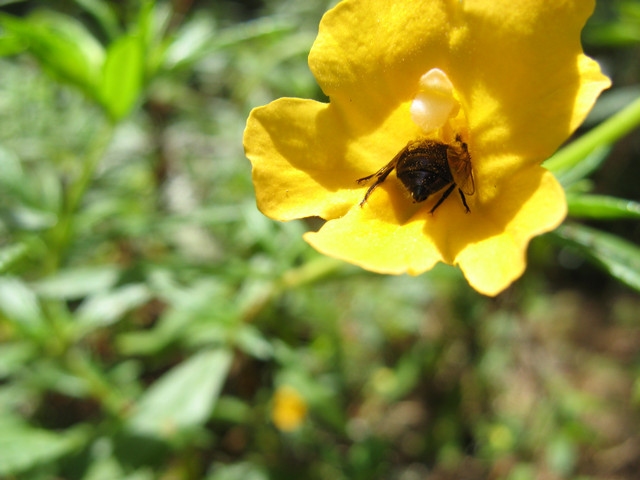
I also saw a bee at work on these blackberry blossoms and another one that seems to have passed out drunk from the monkeyflower nectar.  He didn't move for a good minute or more.  Better for my camera.
 I don't know if I'm more aware, but I swear that some plants are more common now than just a few years ago.  California rose for example is scattered along the trail in quite a few spots now.  Here's a rosehip just starting to form.  And although most of the rose blooms were done for the year, a few more were getting ready to open.
Another reason I came to the preserve was to look for California hazelnuts (Corylus cornuta var californica).  Also edible, but not quite ripe.  A very strange, but beautiful housing for the future nuts. And the buds just awakening.
And I wanted to see if there were any ribes berries to sample.  The ribes species that grow in the park I don't think are very tasty, but I'm still curious to try some.  They weren't ripe either.
It seems like our wet and late winter pushed some things back from their usual cycle.   Luckily I didn't mind just having a pleasant walk through the woods.

Wednesday, June 23, 2010

World Cup Grass

So in honor of the US qualifying this morning for the second round of the World Cup (my current obsession which is keeping me from blogging), here's a quick post on the controversy of the grass used for this year's World Cup in South Africa.  (Though probably not as controversial as one of the referee's calls.)  Evidently the original plan was to use kikuyu grass, which is native to Africa, overseeded with rye grass.  Kikuyu is the norm on fields, or pitches, as some of our English-speaking cousins call them, in South Africa.  Rye grass the norm in Europe.  Evidently the kikuyu is tough and has a bit of bounce to it.  But FIFA, the world-governing organization for soccer decided it wasn't green enough for television.

My favorite line:  ''The ryegrass requires more water, fertiliser and maintenance than kikuyu."  But as we all know people must have their visually perfect lawn.  The rye grass fields won't last past the winter and will be replaced with kikuyu after the show.

Sunday, June 20, 2010

San Pablo Reservoir

So about a week ago, I went on a short hike with a friend of mine near San Pablo Reservoir in the hills between Orinda and El Sobrante (East of Berkeley).  It was a nice sunny day and I was surprised by some of the plants I found, since I assumed it would be overrun by exotics.

Indian paintbrush.  Always one of my favorites.
Lots and lots of monkeyflower.  Such a beautiful flower, too bad it's not always a garden-worthy plant.
I think this is pearlyeverlasting, something I've never seen, but when I saw it I figured this must be it.  A very descriptive common name. [edit: Thanks to Katie at Nature ID, it looks like this is probably California cudweed - pseudognaphalium californicum.]
And I think at least some of this is purple needlegrass.
And anyone know what this beautiful little flower is?  [edit: A second thanks to Katie at Nature ID for this one, Platystemon californicum, or California cream cup. A lovely little flower.]

Thursday, June 3, 2010

More about bees

So I'm a little behind in posting.  What can I say, it's summer.  But here is a really interesting, and short, article my cousin (the bee expert) shared.  It's about a bee species found in Turkey and Iran at least.  Enjoy.

Tuesday, May 25, 2010

Stop - Don't do this! Invasives

So I'm going to help a friend work on/design her front yard.  I can be a bit controlling, so I'm letting go and said my only rule is not planting any invasives.  We all make mistakes and I've made a few, but we should really just obliterate some plants from our landscapes. 
Here is a stretch of dirt along a wall outside the MacArthur Bart Station in North Oakland.  It contains 4 of our most invasive species all rolled into one tangled mass.
In the closeup you can see cotoneaster, vinca (periwinkle), and ivy.  Not pictured is Himalayan blackberry.

Why are these so terrible?  Well cotoneaster makes big, thorny thickets and just seems to reseed all over the place thanks to the birds.  Vinca will form a huge mat, keeping any other low-growing thing or seedling from growing.  And ivy here in the East Bay tends to just blanket hillsides and swallow up shrubs and even trees.  Not only do these guys spread, but they limit the diversity of plants in that area.

Instead of cotoneaster, plant toyon, a native plant that has similar foliage color and similar berries in the late fall/winter.  Though I think the toyon berries are nicer because they are a truer red, whereas cotoneaster berries have an orangeish tint.  So toyon branches can make a nice Christmas decoration.

We actually have a native blackberry (Rubus ursinus).  Why not plant that one?  Or maybe ollalaberries, not native, but not invasive as far as I know.  As for ivy and vinca, there are tons of groundcovers to choose from that will do the same job, but not get out of control.

I'm by no means a native purist,  but I think we should all agree to at least not plant things invasive in our areas.

Saturday, May 22, 2010

Modern corporate garden in Emeryville

 So I've been wanting to do a post about this for a while.  This is a small garden/park attached to the Novartis building in Emeryville on Hollis Street.  It's pretty simple and maybe not my exact style, but it is definitely interesting.  I drove by this place pretty regularly for over 2 years.  Most of the year it's not too exciting.  But in the spring, the aloes all bloom at the same time in one massive show of color.
It's very eyecatching and it's a good use of a small space.  The Aloes are right on the sidewalk next to road and so draw your eye in to the mini park in an area that's otherwise, semi-industrial/corporate.  And the trees blossom at about the same time, so there is more interest beyond.
And also these other flowering succulents grab your attention further back.  These add some contrast all year, but for most of the year it's not as magnetic.  I do always think of this spring show when I drive by, regardless of the season.  The redwoods along the outer edges are planted a little close and I think might cause problems in the future, but all in all a good use of some corporate cash.