So I'm back. Two weddings in the last month. But weekend before last I spent my Sunday morning up at the Redwood Regional Park here in Oakland volunteering. The East Bay Regional Parks have ongoing volunteer projects for habitat restoration. I was interested in doing something in the parks where I frequently hike here in the Oakland Hills. I missed the one in the Huckleberry Botanic preserve, the second Saturday of every month, but had time for the riparian restoration project in Redwood Park the second Sunday of every month.
I've been wanting to do this for a while, but a week or two before I volunteered, I was hiking in the park and saw lots of colored flags marking native plants that had been planted along the stream that runs through the park. I thought what better way to spend a Sunday morning than planting natives along a a beautiful creek.
Well I didn't quite get to do that. Instead I and several other volunteers were up on a sunny slope cutting down French broom and then pulling the stumps out by the roots. French broom is incredibly invasive here in the East Bay hills and crowds out or shades out natives. I had no idea it got as tall as it does. I was cutting down broom 10 feet tall. I always assumed they were small shrubs, but they in fact get to the size of small trees.
Though not quite what I expected I had a good and rewarding time. All of the volunteers were friendly and Pamela, who works for the park district and organizes this volunteer group, could not have been more helpful. They showed me areas they had already cleared and all of the natives that were discovered hiding under there, or other areas they replanted with natives. I myself uncovered/rescued 3 live oaks. One might have been able to compete with the French broom at 12 feet high, the other two could not at chest high and 10 inches high. I also found a tiny bay, 2 ribes and a sword fern. Very cool. I'm sure the seedbank of broom is quite high, but I'm sure there are also some other native seeds in their two that might now have a chance.
I didn't take any pictures, but here's a youtube video posted by a volunteer named John, who I was working beside for most of the morning. In it you see the ingenious weed pullers that easily yank the broom out, rootball and all.
Thursday, October 21, 2010

Tuesday, September 21, 2010
Wild Berries in the Sierra Nevada


The first berries we found were along a creek on some species of Ribes. They had thorns on the stems so they would fall under the common name gooseberry I think. Not sure which one specifically since our book just said there were various species of Ribes scattered throughout the Sierras. It had small red berries. Near the creek, they were a little mealy and not so sweet, but higher up they had a pleasant tartness balanced with a little sweetness.
In the same area we found twinberries. Beautiful, plump glossy berries looking like conjoined twins. My recent favorite book Flavors of Home describes them as officially edible, but not good to eat, at least here in California. Further north in Oregon, they are supposedly prized and considered tasty, here in California no mention is made. I now understand why. I tried one, just to see, even after my friend said they weren't worth it. It had a pretty foul taste. So foul we had to go back and eat some more Ribes berries to get the taste out of our mouth. Ah well.
On the last day, on our way home, we stopped for another short hike. We walked through the woods, it was quite beautiful, but then we found some thimbleberries. I had heard they were really good, but had never found them ripe. They are really good. They are kind of like a small fragile raspberry in the shape of a thimble (hence their name). They have a very nice, but complex flavor. Very good.


Monday, September 13, 2010
Birds in Tilden
So on a hike about 2 weeks ago with some friends, I saw two birds in an unexpected place. I see these birds all the time, but I don't usually expect to see them in the trees.
The first was what we believe was a juvenile red-tailed hawk. Red-tailed hawks (Buteo jamaicensis) are very common not just here in California, but throughout North America, and their range extends to islands in the Caribbean and down through Central America. They are quite variable in coloring and here in the West they have three forms, light, dark and intermediate. The dark are completely dark brown, so it looks like that's what we've got below. For more pics and more info, check out this post on 10000 Birds.
 The second bird was a turkey vulture (Cathartes aura), just sitting in a tree a mere 20 feet from the trail. It wasn't a tree on the edge of a clearing, we were in the woods. We thought maybe it was hiding from something, but really we had no idea. This bird too is a juvenile. It's head is grey instead of the characteristic red of the adults. Turkey vultures are the most widespread of the New World vultures from Southern Canada to the end of South America.

 These are two birds I think of when I think of open space here in California. I often see them on hikes or long car rides in less populated areas. But it looks like people all over North America probably think the same.
And as an added bonus, here's a pic of a heron (I believe it's a great blue heron) that I saw while paddling down the Russian River in a canoe over Labor Day weekend.

The first was what we believe was a juvenile red-tailed hawk. Red-tailed hawks (Buteo jamaicensis) are very common not just here in California, but throughout North America, and their range extends to islands in the Caribbean and down through Central America. They are quite variable in coloring and here in the West they have three forms, light, dark and intermediate. The dark are completely dark brown, so it looks like that's what we've got below. For more pics and more info, check out this post on 10000 Birds.


And as an added bonus, here's a pic of a heron (I believe it's a great blue heron) that I saw while paddling down the Russian River in a canoe over Labor Day weekend.

Wednesday, September 8, 2010
Wild Late Summer Harvest
Inspired by the book The Flavors of Home, which I wrote about in a previous post, I decided to try and find a few of the things that are available in August or September.
First I decided to look for some California hazelnuts which are ripe in July and August. While hiking in Huckleberry a few weeks ago I was unsuccessful. But this last week in Marin I was, though not very. Although there were many hazelnut bushes along the trail, I found only two, count them, two California hazelnuts. I ate one on the trail and saved the other to take some pictures.

 The book warns that they are a favorite of squirrels and so hard to find. It tasted kind of like a walnut to me. I don't think I've ever had hazelnuts outside of chocolate though, so I'm no expert. The green sheath below surrounds the nut when it's not yet ripe. And then dries to brown as the nut ripens. Be careful though. There are a lot of tiny hairs on it that will stick in your fingers and hands. Felt kind of like nettle. Peeling the first one, I only got a couple, the second a handful of stinging hairs. The first seemed drier. I wonder if that made the difference. Then you've got to crack the nut to get to the meat.
 Next up was madrone bark. This is the time of year when sheets of the bark starts to dry and curl on the tree and is easily removed. It's used to make an infusion (i.e. tea). I haven't tried it yet, but will definitely blog about it when I do.

 And last up were rose hips of one of our native wild roses. Much like the hazelnuts, I've seen lots of wild roses lately, but almost no hips. That is until I stumbled upon a small group of bushes covered with hips. They are very tiny in comparison to the domesticated varieties. I'm not sure I took enough for more than a cup of tea, but when I have it I'll blog about that as well.

 I was trying to dry them whole, but then decided to cut them in half and dry them in a low oven for about 30 min as per the book's suggestion. Rose hips are high in vitamin C. And rose hip oil is commonly used in parts of Latin America to minimize scarring and as an anti-aging cream. I tried one on the trail. It was pretty mealy. Not so great. The book does say that some bushes have better tasting hips than others and if you find mealy ones, to move on. But those were the only hips I've seen in weeks.
First I decided to look for some California hazelnuts which are ripe in July and August. While hiking in Huckleberry a few weeks ago I was unsuccessful. But this last week in Marin I was, though not very. Although there were many hazelnut bushes along the trail, I found only two, count them, two California hazelnuts. I ate one on the trail and saved the other to take some pictures.


Thursday, August 19, 2010
Swanton Berry Farm and the joys of Highway 1
I might come back with another post or two about my trip to Europe, but for now I'll talk about my trip down the coast towards Santa Cruz this past weekend. I have done this trip many times. My best friend studied at UC Santa Cruz and I visited her there often at the time. And once she moved up to the Bay Area proper we often made trips down the coast to Santa Cruz to visit.
Our regular route is across the 92 to Half Moon Bay and then south. There is a lot to do on this little stretch of coast, and lots of cool beaches right on the side of the highway to stop and hang out at. But what prompted this trip was my desire to go pick berries at Swanton Berry Farm.
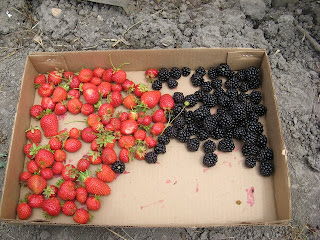
 This is an organic farm that uses unionized labor. How much better could you feel about where your food comes from? Well even better if you pick the food yourself. They have a U-pick service for some of their crops depending on the season. Right now they have strawberries and blackberries. I think they are known locally for the olallieberries, but I missed the season. Next time. Later in the year they also have kiwis to pick. Yum. My best friend couldn't come, but it was easy finding volunteers.

 I have to say the strawberries were some of the best I've ever had. The blackberries were good, but not supersweet. I think they need a little more time to ripen. They were great with a little vanilla yogurt though. The strawberries I didn't want to dilute at all, so they all got eaten fresh.
 If you do decide to cruise down this stretch of Highway 1, I suggest you also stop in Pescadero at the Arcangeli Grocery Co. to try the artichoke garlic herb bread. This stuff is amazing. I always get one loaf to eat on the drive and at least one to take home. There's also the Bonny Doon vineyard for some winetasting and the giant haybale maze at Arata Pumpkin Farm. And of course don't forget to stop at one of the many beaches to eat your bread, berries, and drink your wine.
Our regular route is across the 92 to Half Moon Bay and then south. There is a lot to do on this little stretch of coast, and lots of cool beaches right on the side of the highway to stop and hang out at. But what prompted this trip was my desire to go pick berries at Swanton Berry Farm.


Saturday, August 14, 2010
Alpine wildflowers part 2


Subscribe to:
Posts (Atom)