
Wednesday, February 27, 2013
Acorn experiment #2 - Pancakes
I had some flour from a second batch of valley oak acorns that I had accidentally broiled instead of drying in my broiler. I forgot they were drying under the pilot light and I turned on the oven to cook dinner. Oops. The flour looked good, but I didn't want to serve it to guests just in case. So the other night I decided to try out one of the many acorn pancake recipes I saw on the internet. I finally went with the recipe for acorn griddle cakes at the bottom of this page, but didn't use any wheat flour, just 100% acorn flour, and I think alot more milk. These things were bone dry. I wonder if the recipe is supposed to be made with the damp, freshly leached acorn meal. They were still pretty dry once I cooked them, so I had to use a lot of butter (no complaints here). But they were delicious. The acorn had a great flavor. Served with salmon and a side salad.


Wednesday, December 19, 2012
Acorns for dinner!
So after I leached and dried my acorn flour I invited some friends over for an experimental dinner. I invited the 2 friends who helped me gather and then another friend stopped by purely by coincidence. I decided to make 2 different dishes with the 2 different acorns. I wanted to compare, though the dishes tasted so different it's hard to say which acorn tasted better.
With the black oak acorns I decided to make a soup. I found a recipe for acorn soup online. As always I changed the recipe a bit, substituting things I didn't have or that didn't sound like what I wanted. I didn't have the pear brandy so I substituted red wine. I also never added the cayenne, sour cream, or parsley.
 With the valley oak acorns I decided to make a scramble, an idea I got from Flavors of Home by Margit Roos-Collins. Basically I just sauteed garlic in butter and then added some damp acorn flour, some salt and pepper.
 I paired this with some broiled salmon with a fresh raspberry sauce and some salad made by one of the guests.
The soup was a bit tangy/sour. The two friends who helped gather preferred the soup since they liked that tangy taste. My other friend and I preferred the scramble. Garlic and butter, how can you go wrong with that? A delicious meal. I just finished another round of valley oak acorns. I have about 2 1/4 cups of flour. I'm thinking of trying some acorn pancakes, before preparing the rest of my acorns for a larger dinner in January. And I still have to sample some Tanoak acorns I collected on Mt. Tam.
With the black oak acorns I decided to make a soup. I found a recipe for acorn soup online. As always I changed the recipe a bit, substituting things I didn't have or that didn't sound like what I wanted. I didn't have the pear brandy so I substituted red wine. I also never added the cayenne, sour cream, or parsley.


The soup was a bit tangy/sour. The two friends who helped gather preferred the soup since they liked that tangy taste. My other friend and I preferred the scramble. Garlic and butter, how can you go wrong with that? A delicious meal. I just finished another round of valley oak acorns. I have about 2 1/4 cups of flour. I'm thinking of trying some acorn pancakes, before preparing the rest of my acorns for a larger dinner in January. And I still have to sample some Tanoak acorns I collected on Mt. Tam.
Wednesday, November 21, 2012
Leaching Acorn Meal
So as promised, here's a little more information about leaching the acorns. Acorns have tannins, a lot of tannins. Most acorns have so many tannins that they are not edible without leaching. Some possible problems that I've read they can cause are constipation, stomach upset, nausea or even kidney failure. Yikes. So what to do. You have to leach the tannins out with water.
First you have to grind or pound the acorns into flour. I used a spice/coffee grinder to do this the first time, and a blender the 2nd. With the blender make sure you don't put too much water or the bits of acorn will spin around without actually being chopped down Then to leach out the tannins there are many options. Native Californians diverted streams over beds in the sand, some people boil the acorns changing the water, or pour hot water over it, others pour cold water over the acorn flour, or tie it to a faucet in cheese cloth and let it drip over night.
 I opted for yet another option I found on page 5 of Suellen Ocean's "Acorns and Eat 'Em". I didn't need the flour right away, so I put the acorn flour in a jar and filled it with water. I shook it up and put it in the fridge to let the flour settle out. Once or twice a day I would pour the dark, tannin-filled water off the top, fill the jar with fresh water and put it back in the fridge. I read you need to do this for a week or 2, depending on the type of acorn, until the water gets clearer. After two weeks, the water was definitely lighter, but still pretty dark. So I decided to run some water through it. I lined a strainer with cheese cloth and dumped the acorn meal in. I left a small stream of water pouring out of the faucet to keep the strainer filled with water for a couple hours. Normally you do this overnight, but I had already leached a lot of the tannins out in the jar.

 I learned that cheesecloth is not the best method to do this. A lot of the acorn flour got stuck between the layers of cheesecloth. It was difficult to remove. So round 2 I used a linen dishcloth. Much better. I had no immediate need to use the flour, so I squeezed out as much water as possible, spread it out on a cookie sheet and put it in a warm oven. Stir it occasionally and break up any clumps. When you're sure it's dry you can store it. Many things I read said to store it in the fridge since acorn flour has a lot of oil and can go rancid if stored at room temperature for too long. Others said it's not a problem, but to be safe I stored it in the fridge.
 On my second round there was less flour. After two weeks the water was pretty clear. I put it in the strainer and just filled the strainer a few times until the water ran clear, then dried that flour as well. Now I had some flour to experiment with, which I'll describe in my next post.
First you have to grind or pound the acorns into flour. I used a spice/coffee grinder to do this the first time, and a blender the 2nd. With the blender make sure you don't put too much water or the bits of acorn will spin around without actually being chopped down Then to leach out the tannins there are many options. Native Californians diverted streams over beds in the sand, some people boil the acorns changing the water, or pour hot water over it, others pour cold water over the acorn flour, or tie it to a faucet in cheese cloth and let it drip over night.


Wednesday, November 14, 2012
Acorns - The Harvest
Well it's been a very long time since I last blogged. A little harder to keep up with this when I no longer have a garden. I've been doing a lot of hiking and camping in the last 6 months. Perhaps more on that later. But since it's Fall and Thanksgiving is approaching I thought I'd post about my current attempt to eat acorns for the first time.
I attempted to harvest some last year, but got to it too late and basically got a small amount of wormy acorns. Not fun. This year I was a lot luckier. I was able to collect acorns from both the California Black Oak (Quercus keloggii) and the Valley Oak (Quercus lobata). *The common names are often used in other regions to refer to different oaks* As you can see from the picture the acorns look very different.
 The black oak acorns are on the left above. They are much smaller and rounder. The valley oak acorns on the right are much longer and bigger. And once they are cracked they are very different as well.

 Just to confuse you all, in the bowls, the shelled valley oak acorns are now on the left and the black oak acorns on the right. The black oak acorns have a very difficult to remove skin. Especially hard with undersized acorns of which I had more than my fair share. I read somewhere to sprinkle them with water, let them dry and then rub the skins off. I had to do this twice, but it definitely helped speed up the process.
 Then into my spice grinder and the flour (which smells really nice) into a jar with some cold water. And into the fridge. You have to leach the tannins out of acorns to make them safe to eat. More on my adventures in leaching the acorn flour in my next post.
I attempted to harvest some last year, but got to it too late and basically got a small amount of wormy acorns. Not fun. This year I was a lot luckier. I was able to collect acorns from both the California Black Oak (Quercus keloggii) and the Valley Oak (Quercus lobata). *The common names are often used in other regions to refer to different oaks* As you can see from the picture the acorns look very different.


Tuesday, May 22, 2012
Eclipse and blooms in the Sierras
So I went up to the Sierras with some friends to see the annular eclipse this last weekend, and was also pleasantly surprised to see a lot of spring flowers. First some pics of the eclipse and the weird suncircles that would filter through the leaves of the trees.

 And now onto flowers. The dogwoods were in bloom. This one was next to our campsite.

 I've never seen so many fairy lanterns (Calochortus albus) before. They were scattered all along this trail.


More after the jump.


More after the jump.
Sunday, February 5, 2012
Angel Island
So the bizarre weather continues. It being Super Bowl Sunday today, I decided to take advantage and go to Angel Island out on the bay. We caught the ferry from Tiburon.
 Had some great views of the Golden Gate Bridge on the ride over, and from the island itself.
 Hiked up the North Ridge trail to the top of Mt. Livermore, the highest spot on the island. Saw a lot of California hazelnut (Corylus cornuta) with long dripping catkins along the way.
 And fields and fields of Star Lily, or Death Camas (Zigadenus fremontii) Most haven't bloomed yet, but quite a few have.
 Although there were some signs of the fire in 2008, which apparently burnt about half the island, the island seemed really green to me. The north side of the island is still heavily forested and there were quite a few big oaks and other trees in other parts of the island.
 We saw one deer, several hawks and vultures, and not too many people. A really spectacular day. In the 60s, sunny, almost no wind and great views. All at the beginning of February.


Saturday, January 14, 2012
Volunteer sunflower in January
So in case you haven't stuck your head outside, or don't live in the western region of North America, the weather has been unseasonably warm and dry. So warm and dry in fact that my neighbors yard has a volunteer sunflower! Not the mightiest of sunflowers, only about 2 1/2 feet tall, and already looking worse than in this photo from a couple days ago, but still, very strange. The weather is finally supposed to start to cool, and rain is forecast for the middle of next week, so I'm off to the local pool to enjoy it while I can.


Friday, December 23, 2011
Happy Solstice, Christmas, Holidays and New Year
I went to a solstice celebration in Muir Woods 2 days ago. They opened most of the main grove for free from 3-8pm. Music, carolers, children running around with flashlights. It was good fun. And they lined the path with luminaria, something I know more from my time in Arizona. A great way to guide people through the trees without the need of flashlight. But as you can see, it's really dark under redwoods at night.

I've had a very busy 2011 and have not been blogging, but will be back in 2012. A very merry season to you all. And from here on out the days just get longer.

I've had a very busy 2011 and have not been blogging, but will be back in 2012. A very merry season to you all. And from here on out the days just get longer.
Friday, April 15, 2011
Garden Bloggers' Bloom Day - April 2011
The tax day addition. Fortunately for my procrastinating self, taxes aren't due till Monday, and my first appt was a no-show, so I have time to blog a bit.
On my little patio/potted garden I have a couple things blooming, the first four Ca natives. The biggest surprise were my western bleeding hearts (Dicentra formosa). They die back completely in the dry season, and I mean completely. I was a little afraid they wouldn't come back, but a couple of weeks ago they started leafing out and today, blooming beautifully.

 My redwood sorrel (Oxalis oregana) has been green continuously, but just started flowering for the first time in almost a year. I like the second pic. I looks like the one flower is incredibly shy.

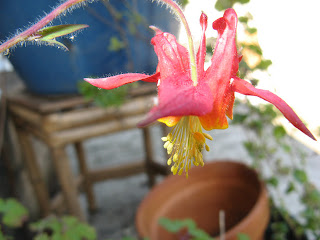
 The columbine (Aquilegia formosa) has also just started to flower. It's also covered in these monstrous giant bugs. Well they look that way with my macro lens. Way to go macro lens. Boo to the bugs. They were actually pretty small, and have now met their doom.

 The last of the Ribes sanguineum glutinosum. It was actual beautiful last bloom day, but I wasn't around to blog about it.

 And this volunteer oxalis in one of my pots.
 Happy bloom day, and thanks as always to Carol at May Dreams Garden for hosting bloom day.
On my little patio/potted garden I have a couple things blooming, the first four Ca natives. The biggest surprise were my western bleeding hearts (Dicentra formosa). They die back completely in the dry season, and I mean completely. I was a little afraid they wouldn't come back, but a couple of weeks ago they started leafing out and today, blooming beautifully.


Sunday, April 10, 2011
Hiking in Redwood Regional Park - 1 New, 1 Old
So my blog is now 2 years old, as of a couple days ago. I'm mildly proud of that, even though I haven't been blogging as much as I would like to. Completely unrelated, this year I've been trying to see parts of the Bay Area that I haven't seen before. This can be exploring a new park, new hot springs, a new restaurant, or something as simple as hiking unfamiliar trails in a familiar park. This post is a conglomeration of photos from hikes I did about in Redwood Park about 3 weeks ago. The first, hiking out of the serpentine prairie (new) and the second leaving from Skyline Gate(old).
 For the first hike I went up to the Serpentine Prairie (see my previous post about this area here) and then went out the Dunn trail and back on the Golden Spike trail for a short loop.
The first blue dicks were out, as were some tiny insects. Are they flies, tiny bees?
 A field of common star lilies (Zigadenus fremontii).

 And does anyone know what this is? It looks like red asparagus. It was growing in some shade under oaks I believe.

 Find the other hike after the jump.

The first blue dicks were out, as were some tiny insects. Are they flies, tiny bees?


Saturday, March 19, 2011
Alien life forms at Huckleberry Regional Preserve
I went to Huckleberry a couple of weeks in search of Ribes sanguineum blossoms. I found that and quite a bit more. One of the storms seemed to have knocked a tree over at the beginning of the trail. But I saw some people coming up that part of the trail so I went on down. Shhh, don't tell. I think it was only for liability reasons anyway.

 The ferns were emerging from their dry season slumber.


These weird shapes were on the madrone trunks.


 More after the jump...


These weird shapes were on the madrone trunks.


Friday, March 11, 2011
Catch up - Photos of Mt. Diablo with Snow and Roasting the Bay Nuts
A few days after my aborted attempt to see snow on Mt. Diablo, I went out to Walnut Creek to do some work. Luckily my friend was driving. He was even nice enough to pull over, but strangely the best pics were just taken through the windshield while moving.


And I realized I did in fact take some pics while roasting the bay nuts. The shells are very easy to remove, leaving two halves of a creamy colored nut. The 2nd and 3rd pic are the roasted nuts. The 2nd picture is without flash and the 3rd with. The actual color of the roasted nuts is somwhere in between, think a ruddy chocolate brown.


And I realized I did in fact take some pics while roasting the bay nuts. The shells are very easy to remove, leaving two halves of a creamy colored nut. The 2nd and 3rd pic are the roasted nuts. The 2nd picture is without flash and the 3rd with. The actual color of the roasted nuts is somwhere in between, think a ruddy chocolate brown.


Subscribe to:
Posts (Atom)